Enter this competition to for your chance to win a copy of The Enemy Inside!
Or click on this link to purchase your copy at Amazon
Book Depository
http://www.bookdepository.com/Enemy-Inside-Vanessa-Skye/9781612131832?b=-3&t=-20#Fulldescription-20
Enter this competition to for your chance to win a copy of The Enemy Inside!
Or click on this link to purchase your copy at Amazon
Book Depository
http://www.bookdepository.com/Enemy-Inside-Vanessa-Skye/9781612131832?b=-3&t=-20#Fulldescription-20
My book is available for pre-order! http://www.kobobooks.com/ebook/The-Enemy-Inside/book-BLBTsT8lGUeS4di3-votWQ/page1.html?s=Ji6i29v2Pk6fes-Mj8Xezw&r=1
Get it! Get it now!

So, before I read an except from my upcoming crime fiction novel The Enemy Inside, I wanted to talk a little bit about how I got to this point, in case there are any other budding writers in the audience and to show you that not all novelists are insular alcoholics. Just kidding, I’m not insular.
When you dream of writing a book, it’s very easy to get caught up in the ‘shoulds’.
I SHOULD have the entire book planned out from beginning to end before I write it.
I SHOULD have a degree in English literature from Harvard.
I SHOULD love the classics, and aim to write for posterity.
I SHOULD have an impeccable literature pedigree and be the love child of Jane Austen and Tolstoy.
Well, I am here to say that this is utter crap. When it comes to writing a novel, there are no shoulds and shouldn’ts. All there needs to be is a love of what you are doing.
I have wanted to be a writer for as long as I can remember. But like most wannbee novelists, life got in the way. And I let that be my excuse, because the alternative was too scary. Write a book? No way! Put my heart and soul on paper and have it rejected and critiqued? Are you kidding?
I started my career as a cadet journalist in the central west of NSW. I wrote a lot of stories about sheep and cows. I remember a personal highlight was visiting the cattle yards to do a story on a five-legged cow. I came away from that experience with a deep and profound sense that I needed to do something else with my life, and that I needed to become a vegetarian.
Because this job was making me tired of words, I decided to make the foray into PR, and eventually found myself managing a PR company in Sydney for Satan, beset by ungrateful clients and ‘unreasonable’ journalists.
Anyway, I loathed this job. I loathed it to the point where I actually wished to get hit by the 190 bendy bus on the way to work in the morning. And it wasn’t helped by the fact that every night I would dream of writing the first chapter of a book. Every night it was the same damn thing, the same words, the same computer screen, over and over, and this went on for about a year.
Eventually, I got so fricking tired of this dream, I sat down and wrote this stupid first chapter, just to get it out of my head. But the muses didn’t stop at this first chapter, and before I knew it, I had written a significant portion of a book that looked like it was shaping up to be crime fiction. Who knew that was in me?
I quit my job to write this book, not knowing anything about the characters, not knowing how on earth it would end, and not having any knowledge about the shoulds and the shouldn’ts of the writing world.
The point I am trying to make is this: I am not a brilliant writer; year 12 students will not study my work 100 years from now while sitting on the Death Star. But I am persistent to the point of insanity.
I wrote this book, even though I couldn’t afford to not be working. I ignored the rejections, and trust me, there were many. I sat down at my computer to write, without any clear idea of what words might come out of me that day. I did it for the love of it, and if I can, anyone can.
I shudder to think what great classics will never come to be read because they are still in a head or a desk drawer somewhere. So if you want to be a writer, be one, you don’t just owe it to yourself, you owe it to me and every other lover of books out there.
With that in mind, I’ll read the first few chapters of my debut novel, The Enemy Inside, which will finally be released in August this year, seven years after I first had the dream that inspired it. And yes, the first chapter is almost word for word of that dream…
Trigger warning! There are descriptions of assaults and violence in this reading that some people may find disturbing. There is also a helluva lot of swearing. But this is crime fiction, so it’s not about unicorns farting rainbows…

So, today I thought I might blog about inspiration. I think many people, when they come to write, are worried about whether their inspiration is the ‘right’ kind, or ‘good enough’. I mean, we’ve all read about those people who get their inspiration deep in meditation on top of a mountan in Brazil–but my muses aren’t that fancy.
In my humble opinion (ok, ok, my opinion in generally not very humble), there is no right or wrong when it comes to inspiration.
The inspiration I received for my first book, The Enemy Inside, was so persistent that it almost drove me mad. I was working in the PR job from hell at the time (I’m not sure my boss was actually Satan, but at the very least she was Satan’s number one wife). Every morning I used to hope to get hit by a bus so I wouldn’t have to go to work. But every night, I would go to sleep and dream that I was writing the first chapter of this book. Over and over again, every single night.
Now usually, when I inspiration dream, it’s generally in movie-length, vivid epic complete with casting, sets and costumes. But this was different, in that instead of me either being IN the epic, or closely observing it, this time I was writing it.
It got to the point where I knew the entire first chapter by heart!
Those muses are darn persistent.
Eventually, I got the shits with this—I mean, I had enough going on doing Satan’s bidding without missing out on sleep at night too! So I thought that if I just sat down and wrote out this chapter, that it would get out of my head and I could get on with being miserable in my crap job that I hated. I always had the bus to look forward to, after all.
But hey, what do you know, the rest of the book came out after this first chapter, and I had written it in about a month. I loved writing so much I quit my job and starting writing as much as possible in between doing freelance writing work.
Now, while the book has changed quite a bit and details have been added, Chapter 1 is still very similar to that very insistent dream.
Many people may think it’s pretty naff to say you were inspired by a dream, but we are now so busy in our daily lives, that, frankly, I have no idea how the muses would ever reach us if it wasn’t for sleep.
Apart from really inconvenient moments, like meetings, intimate dinners and parties, I still mostly get inspired by my muses while I dream, and as a result I keep a notepad by the bed to jot it all down (no, you will never remember it in the morning—write it down there and then!).
So that’s my story, may the inspiration be with you.
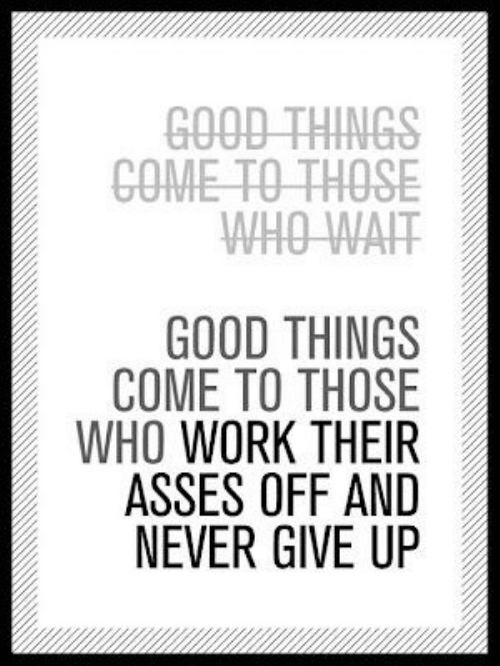
If there’s one thing that is true of writing, and indeed life in general, it’s the absolute requirement to never give up.
Yet so many writers are stymied by the very first stumbling block—be it the first rejection, or their grandma didn’t like it, or someone just put out something similar—and give the entire game away. I shudder when I think of how many bestsellers are buried in a desk drawer somewhere because a moron somewhere (likely an assistant of an assistant of the third letter filer on Wednesdays) didn’t like them.
You may have heard these excuses: ‘It’s all about luck’, ‘People who get published know someone in the industry’, ‘I don’t have time’, ‘I don’t have the right degree/qualifications/the right to express myself creatively’, ‘I’m happy in my horrible job, really.’
I call bullshit.
I do not believe that the writers who get published are the most talented, or their books are the most well-written *cough, Twilight, cough*, or that they’re even lucky. I believe the almighty published are those who are the most determined to succeed and who believe in themselves and never give up.
And let’s face it, if you don’t believe in you, how can you expect anyone else to?
When I gave up my high-paying, soul-sucking job in PR six years ago, I did so with the firm belief that I wanted to write books for the rest of my life (I had always had this conviction, I just got distracted along the way :)). It was a pretty big leap of faith, and I had to believe in myself.
I’m not the best writer in the world, and my books aren’t going to change society (that’d make for a pretty cracked society), but darn it, if I have one redeeming feature it’s that I never give up.
And if someone tells me I can’t do it (which they have, natch) that just makes me want to do it more. So ner! *pokes out tongue*
Writing is hard. And plonking your still-beating heart down on paper for someone to critique is understandably confronting. But you can’t please everyone, and just because you’ve had 10 ‘nos’ doesn’t mean the next answer isn’t going to be a ‘yes’. Remember, Harry Potter was rejected by 12 publishers before being picked up (bet those other publishers are crying into their unemployment letters now).
But, you can know for sure you’re never going to succeed if you don’t a) finish writing a book, and b) show it to someone.
I’ve said it before (a lot), but it bears repeating: I’d rather die knowing that I tried and failed, than regret having never tried at all.
So believe in yourselves, peeps, and believe in the work. You’ll get there in the end if you want it enough and are prepared to put in the work.

This is enough to make most writers reel in horror. ‘You mean I’m not done yet?!” they cry. “But I’ve been writing this for (insert inordinately high number here) years!”
But, sadly it seems to be a universal truth. I’ve talked in my previous blogs about how much first drafts suck. Because they do, they suck like a breastfeeding octopus. And this is not just the case for new, untrained writers—it is true of all authors, as you can see from the quote above. If there is an author anywhere who published a first draft as it stood, I will eat the 56 copies of my first manuscript that I have laying about the house* (some of those are on thumb drives, too, which can’t be great for my insides—so you can see how serious I am about making my point).
My first book The Enemy Inside is currently on its 8th incarnation (including a title change), and it hasn’t even been published yet! When I think about what my publisher will want to do to it ON TOP of what I’ve already done, I shudder and reach for the gin.
But I can also appreciate the process. The draft I am working with now with my agent is entirely different to the first draft I sent to a manuscript appraisal service five years ago (thank god that crappy draft didn’t go anywhere important!). Characters are more three-dimensional, plots lines are fleshed out, sub-plots appeared and the ending is different. And each appraiser/editor/agent that has got their hands on it has made it a bit better (ok, a lot better).
Of course, there is something you need to maintain during the editing process—artistic integrity. I have not taken on all the suggestions made by agents/editors, because some of them were not in keeping with my vision for my characters, and some of them were just plain dumb (don’t you love how some editors give it a cursory glance and then think they know your characters better than you do?? Bitches—please!). I had two Australian publishers try and get me to change the setting of The Enemy Inside to Australia, which I would not because it didn’t feel it was true to the work. Of course, they didn’t sign me, but I am comfortable with my decision. (Really, I am. I don’t cry myself to sleep at night at all—why, what have you heard?).
We all know that we writers can be a weensy bit precious when it comes to our babies. Like the mother of a newborn with scarily big ears, we do not see the imperfections in the work. We see helpful critique as criticism, and we do not like criticism, we take it very personally (about as personally as telling a mother that her baby has big ears—don’t ever do that).
So be prepared. The editing process is long, drawn out and painful. But worth it in the end, I think. At least, that’s what I’m telling myself as I redraft my second manuscript, Broken, for the third fucking time.
*Promise does not include self-published manuscripts; I’m not a complete idiot.
So today I thought I’d share with you a few of the writing tips I have picked up over the years, both as a fiction writer and a journalist. In this blog, I’m trying to preach about brevity, so lets just get on with it.
1. When you are writing a novel, think of KISS. That’s right—keep it simple, stupid! Thanks to the technological age, most people have an attention span just shy of that of a cocaine-sniffing hummingbird. Flowery prose and long-winded descriptions of a single sun-dappled leaf may have been de rigueur in days of yore, but frankly the people of yore had more time and less Apple devices to distract them. So try to say it as simply as possible.
2. Keep the majority of your sentences short, consisting of no more than 25 words. Of course, you will occasionally have a longer sentence in there, maybe one per paragraph, and that’s ok. But avoid, at all costs, the long-winded sentence that just bangs on and on and on about one thing or worse totally changes tack in the middle for no reason and goes off onto some random tangent until the reader gets bored, turns on the television or surfs the net and then completely loses track of what you were say—oh look, a kitten!
3. Another great way to keep the readers interested is to vary the length and style of sentences. So some sentences may be brief. And some sentences, such as this one, may be a little longer and include some kind of feature or qualifier. And then you might want to think about adding another brief one. Change it up.
4. Try and stick to around three paragraphs per page, at least. There is nothing worse than one long paragraph that never ends. I loved the Millennium Trilogy, but fuck Larsson waffles on about some nonsense in there. I skipped pages and pages of never-ending paragraphs and still kept up with the story—as far as I’m concerned, his editor should be dragged naked over gravel by his earlobe. Along that vein, each paragraph should deal with a single idea, and each paragraph should include no more than about three to six sentences.
5. Get to the freaking point. Lee Child’s books are an excellent example of this. He leads the reader straight into the story from the first line. He rarely uses sentences of more than 20 words. He keeps descriptions to a minimum. His main character, Jack Reacher, never stops to admire how the sunlight reflects off a dew drop perched indolently on a blade of grass and shatters into a myriad of rainbow-like colors. Reacher doesn’t give a shit and neither do your readers. No—Reacher crushes that blade of grass under his boot as he trudges along because, frankly, he has places to go and people to fuck up. As a result there are no boring spots, which is why I am still up reading about Reacher at 3am.
6. Of course, you will need have the odd description in there. But, like an all-nude strip club, peel back your descriptions to their most interesting elements. I don’t care how amazing it is, no single thing needs more than 100 words to describe it. A neat trick: whenever I feel like a description is overly long or complicated, I try and fit each single sentence on to Twitter. This helps me narrow it down to the most important words.
Well, this list is by no means exhaustive, but it’s a start and it includes stuff I didn’t know until editors started telling me in a not very kind fashion. Hope it helps!
‘What the detective story is about is not murder but the restoration of order.’ –P. D. James
I couldn’t put it better myself.
People often ask me: ‘How can you write about such violence? Doesn’t it depress you?’ The short answer, of course, is no! In fact I quite like it, being the damaged little soul that I am (insert smiley face here). But the long answer to that question is this: my books are not about the violence, the rape, the blood and guts or the forensic wizardry. My books are about the restoration of order and the carrying out of justice.
And justice is a fundamental principle at the core of all people, regardless of race, religion or personal conviction.
I think that with our court systems the way they are; the lawyers, the appeals and the loopholes, that many people feel like there’s no such thing as justice anymore. Particularly when you see murderers and rapists getting less time in prison than those perpetrating crimes such as copyright infringement.
And with the popularity of anti-heroes like Lisbeth Salander and Dexter, it’s clear that the reading/watching public don’t mind a bit of an ‘eye for an eye’ at all. In fact, they love it.
My books are about the tipping point that exists in all people. I think it was Angelina Jolie that once said; “If someone comes into my home and tries to hurt my kids, I’ve got no problem shooting them.” Hear, hear fellow tigress mommy! I couldn’t agree more! And yet some people I talk to don’t recognise there’s a killer hidden inside and it just takes the right set of circumstances to bring it out.
So my books explore this. What is the hidden tipping point in some people? Obviously it’s going to be different depending on the person; but, how far can you be pushed before the switch inside your head flicks? If you’re me, then being cut off in traffic will do it (mofos are lucky I’m not allowed to mount an uzi on the hood of my car).
But if you are hideously wronged, what would you do to get proper justice? What might you be capable of doing that you never before imagined?
And, once that switch is flicked, is there any coming back?
My main character, Berg, struggles against her dark side and has a deep and desperate need for justice. She has done terrible things to get it. So is she a criminal? Or a dealer of black and white justice in a world that only sees shades of grey? And does she get to make that call?
I’ll leave you with those questions, kiddies. Sleep tight.
It’s funny, one of the things I’ve noticed is, when I tell people what I do they always have a friend, lover, family member or distant third cousin on their step-mother’s side who wants to be a writer. So the first thing they ask me is: ‘what advice would you give to someone wanting to be a writer?”
Now, I touched on this in my last blog, but this time I’ll go into a little more detail and give a few tips for all of the writers out there, no matter what stage you’re up to.
Good luck!
 Vanessa Skye, Author